1941–1945: Reformist parties facilitate the rise of the Bonapartist Perón
Since the First World War, the PS has played at one time one wing of the bourgeoisie, at another time another.
The PCA has been doing the same since the mid-1930s. In 1942, the leadership of the CGT, the PS and the PCA condemned the strikes and worked to get Argentina to enter the war alongside the United States (then allies of the USSR), while the majority of the bourgeoisie and the army high command played the neutrality card.
In 1943, the army seized power. In 1945, the PS and the PCA formed a bloc (Democratic Union) with the bourgeois UCR party against Colonel Juan Perón, who won the presidential election. The Justicialist Party gained a mass following and even took control of the CGT [see Tavernier & Laurent (Chesnais), Argentine, pour un bilan du péronisme, September 1976].
1951, the Trotskyist movement falls victim to the senile disease of the anti-imperialist united front
The Fourth International was launched in 1933 against this kind of betrayal by degenerate socialist and communist parties, against any subordination to the bourgeoisie, including in dominated countries.
We are in permanent competition with the national bourgeoisie … In every case where it is a direct fight against the foreign imperialists or their reactionary fascist agents, we give revolutionary support, preserving the full political independence of our organization … under the condition that our organization doesn’t participate in the APRA [Peru], GMD [China], or PRM [Mexico]. (Lev Trotsky, “Latin American Problems”, 4 November 1938, Collected Writings 1934-1940, Pathfinder, p. 785)
However, after the Second World War, Argentine supporters of the Fourth International also capitulated to a ‘national’, ‘anti-imperialist’ part of their bourgeoisie. Initially, the impetus came from the Pabloite leadership of the Fourth International (Pablo, Mandel, Frank, Maitan, etc.), which revised its programme between 1949 and 1951, with the backing of the American SWP, from two angles: to reform Stalinist bureaucracy and to join bourgeois nationalist movements, particularly in Latin America, where this meant joining the APRA in Peru, the MNR in Bolivia, the AD in Venezuela, the PTB in Brazil, the ‘Peronist workers’ in Argentina, etc. (Les Congrès de la 4e Internationale, vol.4, La Brèche, 1989, p. 184-185, p. 288-289).
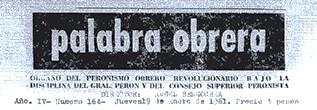
Then, in return, Latin America itself produced revisionist leaders who spread their opportunism and revisionism across the continent and even worldwide:
- in Bolivia, Guillermo Lora (1922-2009);
- in Argentina, Juan Posadas (1912-1981) and Nahuel Moreno (1924-1987).
Posadism (the Latin American Bureau of the ‘Fourth International’ and later Posadas’ ‘Fourth International’) and Morenism (the Latin American Secretariat of ‘orthodox Trotskyism’, later the FB within Mandel’s ‘Fourth International’, Hansen and Moreno, and finally Moreno’s LIT ‘Fourth International’) were chameleons, changing in turn to Maoism, Peronism, Castroism, socialism …
The Argentine PRT-PST-MAS of the late Moreno gave rise to the PTS, the MST, the NMAS, the IS, the NPST, the COR, DO, the PCO, etc.
In 1966, Lora’s Bolivian POR influenced the birth in Argentina of the Politica Obrera group (Jorge Altamira’s PO), which actively opposed the pro-Castro members of Moreno’s PRT-PST (then members of Mandel and Hansen’s Pabloite ‘Fourth International’). In the 1970s, the Politica Obrera (POa), like its mentor, Lora’s POR, linked up with the French Lambertist OCI, which combined formal orthodoxy with practical reformism. In the 1980s, the Partido Obrero (PO, the new name for POa) sank into opportunism and became indistinguishable from Morenism. Such is the origin of the current Argentine PO, POa and POR.
One poisonous legacy of the revisionists is the restoration of a democratic stage of the revolution (hence the use of the slogan of a constituent assembly even in bourgeois democratic countries, where it becomes totally reactionary). Another is the inability to distinguish the workers’ movement from bourgeois nationalism.
We will recover political unity among workers. We socialists recognise that widespread and organic support for Perón took shape over many years as political unity among workers against the ‘gorilajé’ [reactionary supporters of coups against Perón, his PJ and his governments]. The crisis of Peronism has meant the disappearance of this unity among workers … That is why the MAS calls on workers, activists and labour leaders of Peronism … to establish the political unity of our class by creating a great Workers’ Party. (MAS, Programa, July 1985, p. 25)
Centrism is incapable of analysing the concrete situation in concrete terms. It seeks to justify its mistakes and reversals as events unfold. This ranges from the sophisticated variant that replaces Moreno with Gramsci (PTS) to the hysterical Third Worldism of a manipulative guru (DO), via the dispute over the legacy of Moreno, who took so many diverse and opposing positions that one is spoilt for choice when it comes to justifying one’s own opportunism or castigating that of one’s rivals (NMAS, IS, MST, etc.).
Most opportunistic leaders invent, in order to conceal their practical reformism from their base with revolutionary rhetoric, an imaginary world in which the global economic crisis has been deepening since … 1929.
Permanent crises, such a thing does not exist. (Karl Marx, Theories of Surplus-Value, 1861-1863, Progress Publishers, 1968, Vol. 2, p. 467)
In this façade of radicalism, every political crisis is ‘unprecedented’ and ‘hopeless’. For most organisations claiming to be ‘Trotskyist’, China is still a workers’ state, Islamists are leading revolutions, Trump and Milei have no popular base … The problems to be solved by the proletariat disappear through the magic of words.
Revolutionaries sometimes try to prove that the crisis is absolutely insoluble. This is a mistake. There is no such thing as an absolutely hopeless situation … The revolutionary parties must now “prove” in practice that they have sufficient understanding and organisation, contact with the exploited masses, and determination and skill to utilise this crisis for a successful, a victorious revolution. (Vladimir Lenin, “Report on the International Situation and the Fundamental Tasks of the Communist International”, 19 July 1920, Collected Works, Vol. 31, 1966, p. 227)
Except for the PRS-PCO, no organisation learned the lessons of the 2001–2002 experience. But it remained halfway there by breaking with the Permanent Revolution Collective.
2001: a revolutionary crisis left without a programme
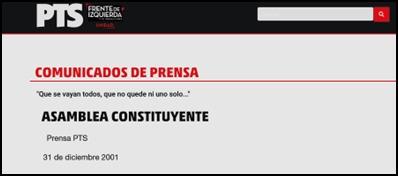
In 2001, an economic crisis that turned into a revolutionary crisis shook Argentine capitalism. No revolutionary solution emerged. The reformist parties (PS, PCA, PCR, etc.) and the supposedly ‘Trotskyist’ parties (PTS, PO, etc.) remained within the framework of populism (‘They must all go’ and pot-banging protests) and the bourgeois State (the slogan of the constituent assembly, dubbed ‘revolutionary’ for the occasion).
Like the bourgeois Peronists, the post-Stalinist PCA, the Maoists, the Guevarists and the Bakuninists, several ‘Trotskyist’ organisations have, since the revolutionary crisis of 2001, had their own ‘piqueteros’ organisation, which is financed by the bourgeois State and redistributes social assistance to its members.
Another consequence of the revolutionary crisis of 2001 was that the PO and the PTS, the two main organisations that emerged from the degeneration of the Fourth International, grew stronger and achieved good electoral results. Due to legal constraints imposed by the State, in 2011 they formed an electoral front, the Front of the Left (sic) and Workers (FIT), which today includes the PTS, PO, MST and IS.
Far from resolving the crisis of revolutionary leadership of the proletariat, these parties are constantly divided over secondary issues. None of them are of the type of the Bolshevik Party of 1907–1921. On the main issues, the PTS, PO, MST and IS share with the traitor parties that emerged from social democracy (PS) or Stalinism (PCA, PCR) a belief in legality, pacifism, parliamentarianism and tagging along a sector of the bourgeoisie presented as ‘the lesser evil’.
All this implies acceptance of the laws of capitalism as a whole. That is why, in a country where chronic undernourishment and malnutrition among children have existed for decades—despite it being one of the world’s largest exporters of cereals and meat—the FIT does not challenge the private ownership of large agricultural estates, nor does it envisage disarming landowners and the repressive police forces that defend them. But this, combined with a monopoly on foreign trade, would enable workers to control the production, pricing and distribution of basic foodstuffs according to social needs.
The Communists are the party of the arming of the proletariat and the poor peasants, the party of insurrection when the time is ripe. The FIT, all of whose components fraudulently claim to be followers of the founder of the Red Army, refuses to take a stand on self-defence. The NMAS is no better.
Despite more than a million votes, demonstrations and rallies attended by thousands of people, the FIT-U’s trade union tendency against corrupt bureaucracies is nowhere to be found.
2002, Peronism back in the saddle
The Partido Justicialista Nacional de la República Argentina (Justicialist Party, PJ), the main traditional party of the bourgeoisie, which inherited a popular base when a Bonapartist from the army—Perón—came to power in 1944, succeeded in regaining control by relying on the trade union bureaucracy, fragmenting and integrating the powerful movement of unemployed workers (piqueteros) that had emerged.
The successive governments of Duhalde (PJ-UCR coalition) and the Kirchners (coalitions around the PJ), due to their close ties of economic and political subordination to the imperialist countries, neither want nor are able to free the country from economic dependence, which is only possible through the mobilisation of the proletariat and the continental extension of the revolution. Like most Latin American countries, Argentina is becoming increasingly specialised in mining, energy and agricultural exports. The only change is that China is beginning to gain a foothold there at the expense of the United States, with the complacency of Peronist governments.
When a new economic crisis struck in 2023 (GDP fell by 1.6% in 2023 and 1.7% in 2024), accompanied by rampant inflation (the price index rose by 135.4% in 2023 and 219% in 2024), the presidential election reshuffled the deck, but in favour of a bourgeois solution that was part of the global reactionary wave. There is no socialist project led by a workers’ party of the Bolshevik type to chart an alternative to capitalism and discredited Peronism.
2022: the attack on Kirchner exposes the opportunism of the PTS and PO
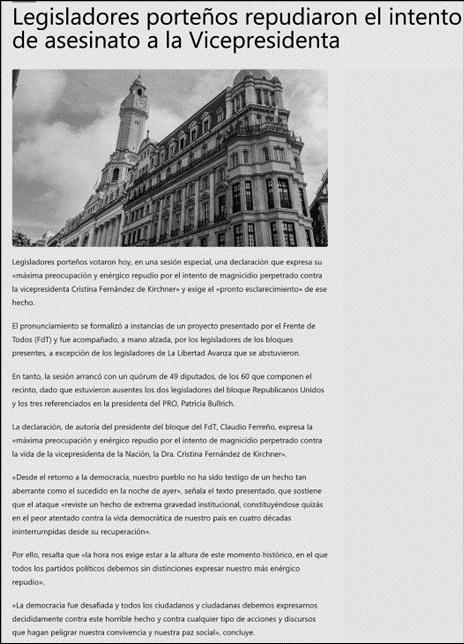
Faced with the 2022 attack by a deranged individual against Kirchner (then Vice-President), the FIT-U deputies in the Buenos Aires provincial parliament (national leaders of the PTS and the main leader of the PO, Solano) voted in favour of the motion put forward by the bourgeois Peronist parties.
This abject behaviour is camouflaged by RP, the sister organisation of the PTS, which split from the NPA at the same time, explaining that the Yellow Vests mark the beginning of a ‘new period’, obviously one of rising struggles.
2023, the ‘anti-caste’ candidate wins
Javier Milei, a bourgeois demagogue who had previously remained on the sidelines of the major bourgeois parties, is running as a candidate for LLA (his ‘libertarian’ party). Milei is an economist from the most reactionary wing of bourgeois ‘economic science’ (the neoclassicals of the Menger and Hayek School) who even advocates the abolition of central banks to give free rein to competition between private banks’ private currencies.
By way of freedom, Milei wants to expand the freedom of capital to exploit, defraud, poison, pollute … He does want to restrict the freedoms of the exploited. Milei and LLA are opposed to democratic freedoms and nostalgic for military dictatorship. The demagogue campaigns against the ‘caste’ of previous governments (of the Kirchners and Macri).
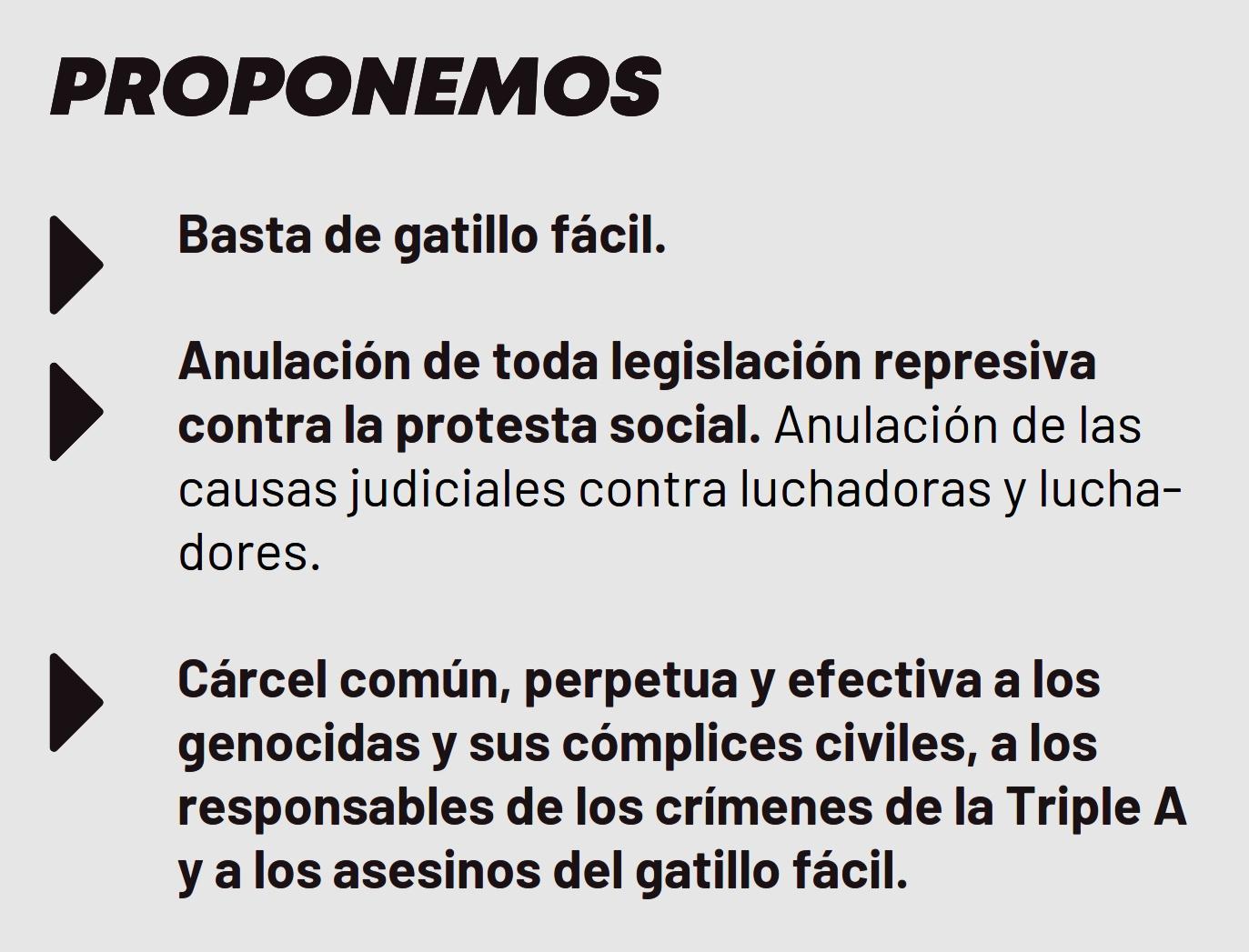
https://www.laizquierdadiario.com/Plataforma-2023-conoce-todas-las-medidas-urgentes-de-Bregman-y-Del-Cano-para-estas-elecciones
In 2023, in the first round of the presidential election, the FIT-U candidate (Bregman, PTS) had nothing to say about replacing the professional army with the arming of the people (which was part of the minimum programme of all parties supported by Marx and Engels at the end of the 19th century), nor on the destruction of the bourgeois state (a decisive part of the programme of the Communist International), nor on the self-defence of the masses against the police and fascist gangs (which constitutes the axis of the transitional programme of the Fourth International).
The reformists systematically implant in the minds of the workers the notion that the sacredness of democracy is best guaranteed when the bourgeoisie is armed to the teeth and the workers are unarmed. The duty of the Fourth International is to put an end to such slavish policies once and for all. (FI, “The Death Agony of Capitalism and the Tasks of the Fourth International”, September 1938, The Transitional Program, IBT, 1998, p. 46)
On the other hand, the FIT-U candidate called for a Constituent Assembly (which, for the Fourth International, only made sense in countries such as India and China in the 1930s and which has just shown its harmful effects in countries where elections already take place, such as Tunisia and Chile).
The second round of the presidential election pitted two bourgeois candidates against each other (Milei of LLA and Massa of PJ). Neither NMAS nor FIT-U called for a boycott. The PO called for a blank vote. The PTS called for ‘not voting for Milei’ while ‘not endorsing Massa’. The IS, MST and NMAS called for ‘voting against Milei’, i.e. for Massa.
Milei was elected by a large margin in the second round in November 2023 despite the open support of the labour movement (confederal leaderships, PS, PCR, PCE, IS) for the rival bourgeois candidate (PJ).
2024, State attacks against the masses, support for Zionist genocide, opening up to foreign capital
Once in power with the Pro and the UCR (which had nevertheless been part of ‘the caste’), Milei systematically suppresses demonstrations. He attacks immigrant workers. He sets about dismantling the social concessions won during previous revolutionary upheavals.
In October 2024, the government introduces a major investment incentive scheme (RIGI).
The government restricts the right to contraception and abortion. Milei unreservedly supports the Israeli genocide in Gaza.
The trade union bureaucracies of the CGT and CTA, as everywhere, have called for a few days of action and, as is often the case, have diverted discontent towards pressure on parliament, where bourgeois parties largely dominate, or towards waiting for the return of a Peronist government after future elections. Each time, their diversions have benefited from the complicity of the reformist parties (PSA, PCA, PCR) or semi-reformist parties (FIT-U, etc.).
Strikes took place but remained scattered, without being able to challenge the executive power. Strikes declined in 2024 and 2025: by June 2025, the number of strikers had fallen by 34% in one year and the number of strike days by 28% (according to the Ministry of Human Capital, 1 July).
2024, FIT and NMAS are sucked into Peronism
In 2024, all these organisations supported the limited work stoppages decreed by the CGT and CTA trade union bureaucracy (which they, like the Peronist bureaucrats themselves, passed off as a ‘general strike’), instead of fighting for a genuine general strike until Milei’s attacks (budget cuts, emergency decree DNU, Omnibus law, etc.) are withdrawn.
The aim is to organise from the bottom up, calling assemblies in workplaces to force the CGT and CTA to call a 36-hour national strike. (PTS, 22 May 2025)
We demand a 36-hour strike from the CGT and a national action plan. (IS, 11 September 2025)
The demand for a 36-hour strike and a plan of action. (PO, 1 October 2025)
What does the ‘action plan’ entrusted to the bureaucrats consist of? In any case, a strike limited in advance to 36 hours has little to do with what Luxemburg called a ‘mass strike’ and Trotsky a ‘general strike’.
The general strike is the response of the proletariat, which cannot and will not accept the bankruptcy of capitalism … This is what makes the general strike so fundamentally important: it clearly raises the question of power. The real victory of the general strike can only be achieved through the proletariat taking power and establishing its dictatorship. (Lev Trotsky, “Preface to the French Edition”, 6 May 1926, Où va l’Angleterre, Libraire de l’Humanité, 1926, p. 10)
These are not craft strikes that have taken place. These are not just strikes. This is the strike. This is the open rallying of the oppressed against the oppressors. This is the classic beginning of revolution. (Lev Trotsky, “The French Revolution has begun”, 9 June 1936, Wither France?, Merit, 1936, p. 150)
On 11 April, under the pretext of investigating Milei, FIT-U deputies (including the main leader of the PTS, Castillo) formed a bloc with elements of the Peronist coalition in the Chamber of Deputies. This is carefully concealed from French workers by RP or from the Brazilian ones by the MRT.
On 10 June, the Supreme Court upheld the 2022 (when Milei was only a Member of Parliament) and 2024 judgments against Kirchner (known as ‘CFK’): a six-year prison sentence and a ban on standing for election.
Opportunists equate the affair with the persecution of a workers’ organisation by a bourgeois state. However, this is not a new Dreyfus affair. Moreover, none of them question the laws prohibiting the theft of public funds by political leaders, nor the facts established by the court, namely the personal enrichment of Kirchner and her family over a period of 12 years at the expense of the Argentine people.
We find here great groups of political speculators, who alternately take possession of the State machine, and exploit it by the most corrupt means and for the most corrupt ends. (Friedrich Engels, “Introduction”, 18 March 1891, The Civil War in France, International Publishers, 1933, p. 18)
The court agrees to allow Kirchner to remain at home. For the NMAS, this concession is not enough. The laws should not apply to the PJ. It urges the corrupt bourgeois party to disregard the ruling.
Rejection of the ban had to be accompanied by a demand that Peronism and CFK refuse to comply with it, a slogan that only the Nuevo MAS party defended within the left. (Izquierda Web, 26 June 2025)
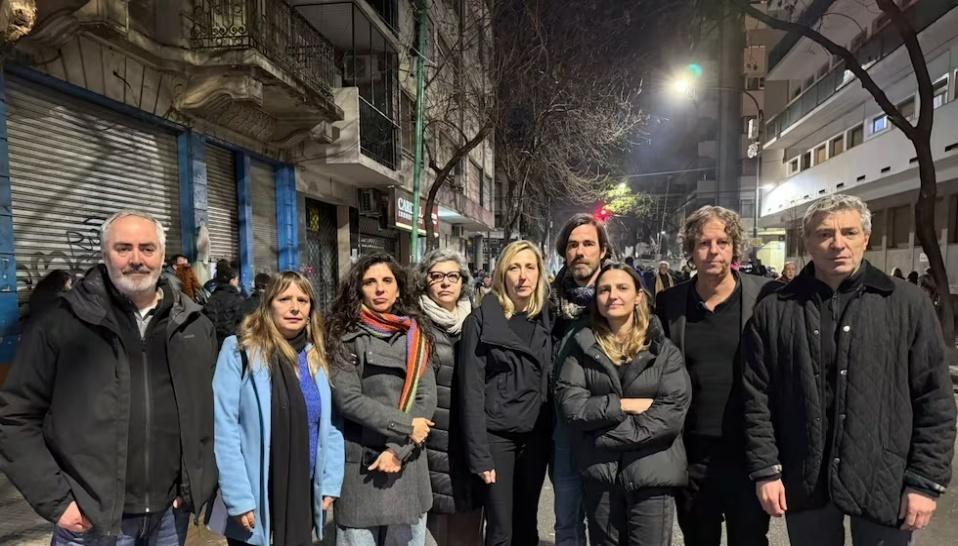
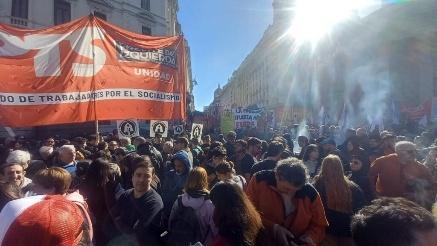
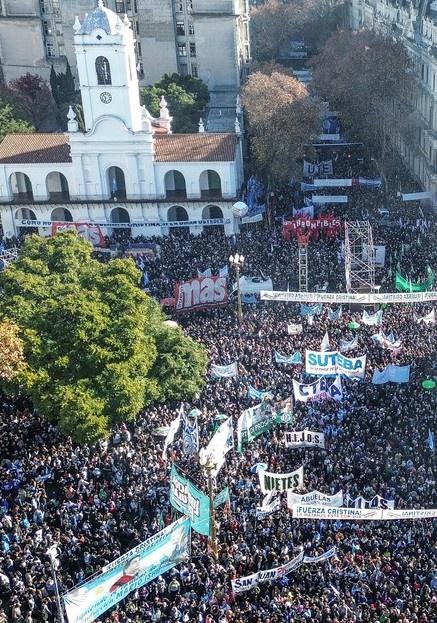
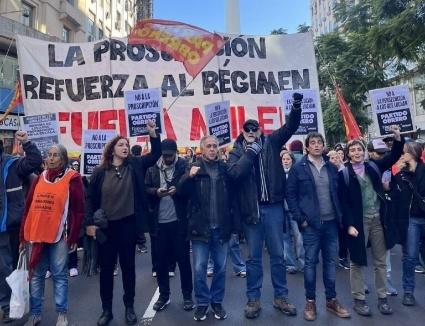
On 18 June, the PTS, PO and NMAS demonstrated in Buenos Aires alongside Kirchner’s bourgeois party to protest against the ruling that prevented her from standing as a candidate.
These shameful alliances with bourgeois parties are carefully concealed by the PCdL in Italy, the RIO in Germany, LI and CTR in Spain, and RP and SoB in France, which also hide the fact that their US counterparts are immersed in the American social-democratic wing (Sanders, Ocasio-Cortez, Mamdani, etc.) that is trying to revive the Democratic Party.
The results of the parliamentary and senatorial elections on 26 October
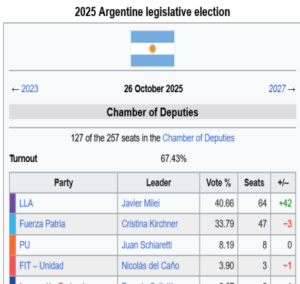
The parliament remains 99% in the hands of various bourgeois parties. The President and his LLA lists (this time including Pro) are benefiting from an improvement in the economic situation (5.2% growth expected in 2025, with inflation slowing to 36.6%). The government is bolstered by the mid-term elections to renew half of the deputies and one-third of the senators.
The PJ is as destabilised as the Democratic Party in the United States or the post-Gaullist LR in France. LLA obtained nearly 41% of the vote in the general election, 7% more than the bourgeois FP coalition led by the Peronist PJ; 42% in the senatorial election, almost 4.3% more than the FP. The presidential party thus gained 55 additional seats in the Chamber of Deputies (bringing its total to 93) and 13 more senators (bringing its total to 19). With its allies from the Republican Proposal (Pro) and the Radical Civic Union (UCR), it can now count on 110 deputies (out of a total of 257) and 28 senators (out of 72).
The PS and the Maoist PCR called for votes for the bourgeois FP electoral bloc led by the Peronist PJ. The PCA presented a few candidates and elsewhere called for votes for the FP.
In previous elections, the FIT-U announced its candidates at a press conference and presented a programme (with a quasi-reformist content). This time, the FIT-U campaigned without any national programme. It obtained 3.9% of the votes cast in the general election and 2.7% in the senatorial election, losing one seat in the Chamber of Deputies.

Two other opportunistic organisations (POa and the NMAS) also presented a few candidates on a line converging with the FIT, combining Gandhi-style pacifism and Boric-style parliamentary illusions.
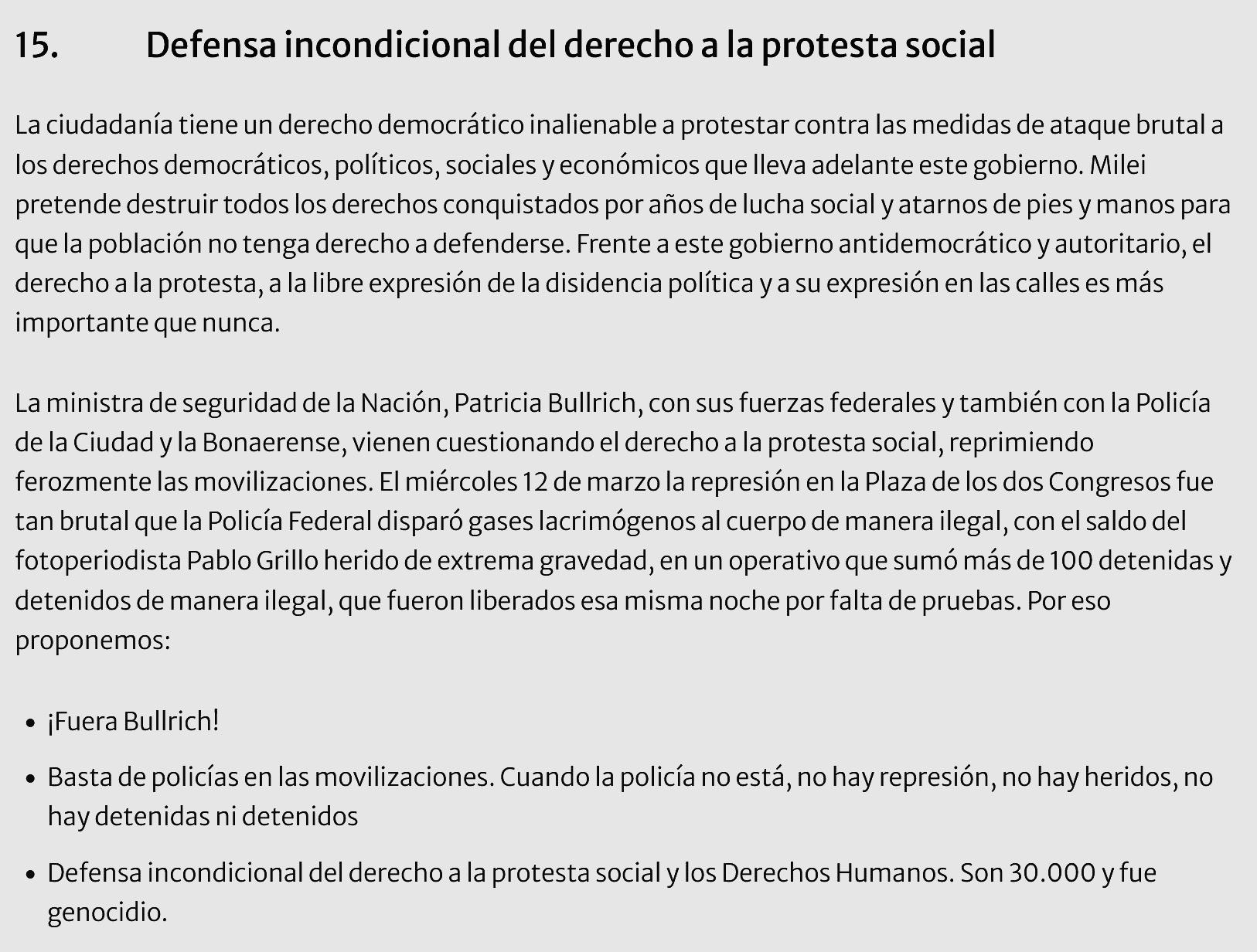
Enough of police at demonstrations. When the police are not there, there is no repression, no injuries, no arrests. Unconditional defence of the right to social protest and human rights… Sovereign Constituent Assembly to propose an anti-capitalist Argentina. (NMAS, Anti-Capitalist Manifesto for Argentina, 17 September 2025)
The NMAS candidate in the province of Buenos Aires obtained only 0.56% of the votes, while the two FIT-U candidates obtained a total of 5.04%.
Although voting is formally compulsory, a third of registered voters did not vote for either the bourgeois parties (LLA, FP, PU, IF, etc.) or the ‘Trotskyist’ FIT-U coalition, it is the highest abstention rate since 1983. This shows the temporary detachment of a significant section of the masses from the bourgeois parties and elections. But this is not, in itself, radical or progressive.
First and foremost, a programme, a strategy, a party!
Enough of purely electoralist blocs! Enough of empty slogans (‘the left’, ‘plan of struggle’, ‘sovereign constituent assembly’)! Enough of capitulation to Peronism! In Argentina, as in the United States, we must seize the opportunity to distance ourselves from the rotten bourgeois party that has discredited itself and served as a springboard for reactionary populists. We must call for a break of the trade unions and organisations of the oppressed in order to form a mass workers’ party based on a programme of class struggle.
Bolstered momentarily by the election results and by a very important emergency financial support from Trump, the Milei government will attempt to redouble its attacks on the working class.
At the same time, the American imperialist state wants to regain colonial control of Cuba, which is already moving towards the complete restoration of capitalism under its own government, and to subjugate the whole of America (it is currently threatening Venezuela, Mexico and Colombia militarily, and putting pressure on Canada to join the US, and on Denmark, aiming to seize Greenland) in order to strengthen itself and prepare for confrontation with the Chinese imperialist state.
It is urgent that revolutionary activists from organisations of watered-down Trotskyism, neo-reformist post-Maoism, Guevarism without peasant guerrilla warfare … break with opportunism and sectarianism, with pacifism and subordination to bourgeois Peronism, and commit themselves to building a Bolshevik-type party in workplaces and schools, in working-class neighbourhoods and the countryside, against the Peronist bureaucrats in the trade unions, women’s organisations and student organisations. This party can only emerge within the framework of a new communist international.
The Fourth International … there is not and there cannot be a place for it in any of the People’s Fronts. It uncompromisingly gives battle to all political groupings tied to the apron-strings of the bourgeoisie. Its task—the abolition of capitalism’s domination. Its aim—socialism. Its method—the proletarian revolution. (FI, “The Death Agony of Capitalism and the Tasks of the Fourth International”, September 1938, The Transitional Program, IBT, 1998, p. 71)